
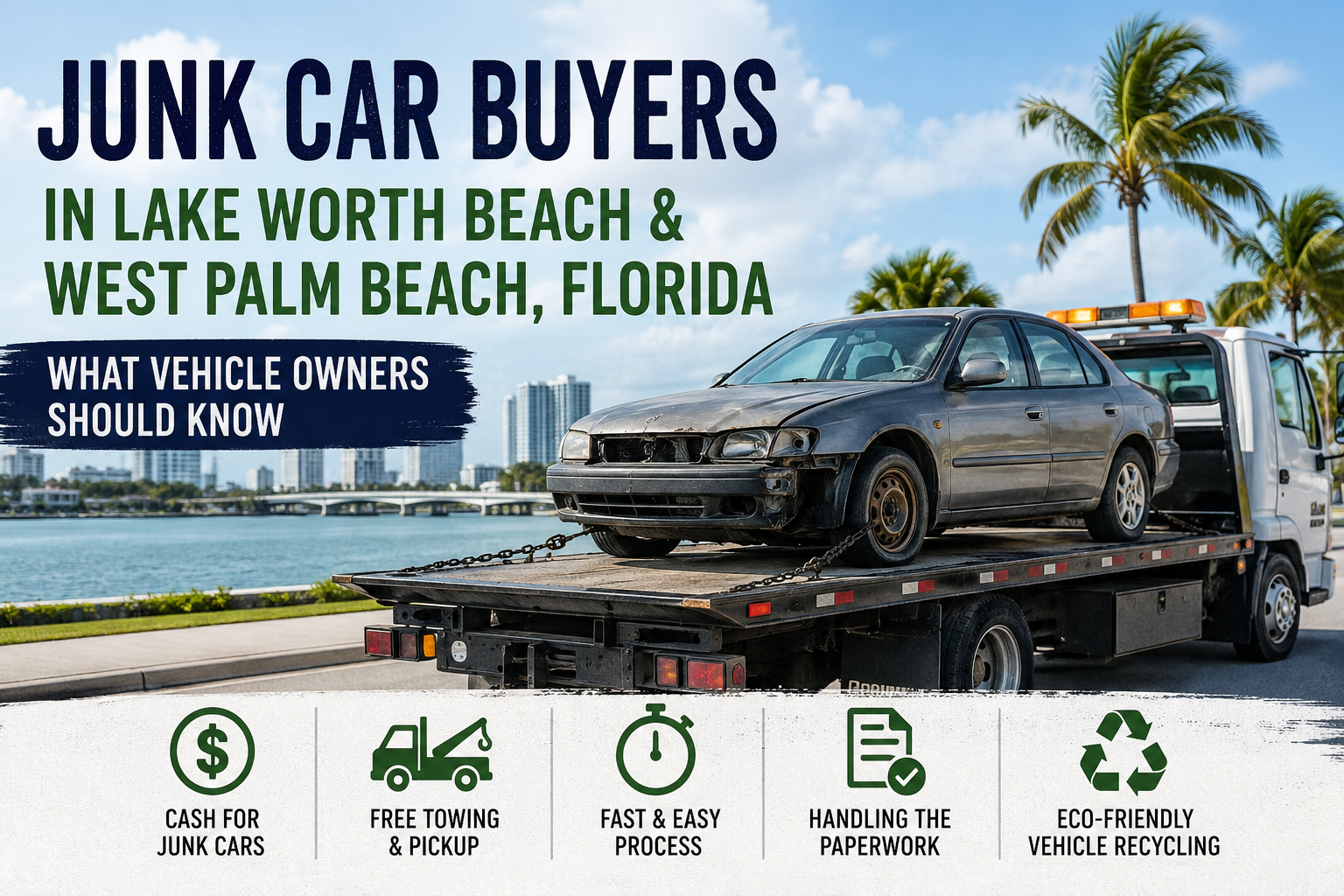
Junk Car Buyers in Lake Worth Beach and West Palm Beach, Florida: A Complete Guide
Every year, thousands of vehicles throughout Palm Beach County reach a point where repairs no longer make financial sense. Whether a vehicle has been involved in an accident, suffered flood damage, experienced a major mechanical failure, or simply accumulated hundreds of thousands of miles, owners eventually face an important decision: repair it, donate it, trade it in, or sell it as a junk car.
In communities such as Lake Worth Beach and West Palm Beach, as well as in South Florida, a large industry has developed around purchasing unwanted vehicles. Junk car buyers, salvage operators, recyclers, and auto dismantlers work together to recover value from vehicles that might otherwise sit unused in driveways, parking lots, garages, or vacant properties.
Understanding how the junk car industry works can help vehicle owners make informed decisions while maximizing the value of an unwanted vehicle.
The Growing Junk Car Market in Palm Beach County
Palm Beach County is one of Florida’s largest and fastest-growing counties. With hundreds of thousands of registered vehicles on local roads, there is a constant supply of aging, damaged, and unwanted automobiles entering the secondary market.
Unlike many northern states, Florida vehicles are not typically affected by snow, road salt, and harsh winter conditions. However, South Florida presents its own challenges. High humidity, intense ultraviolet exposure, flooding, hurricanes, and coastal salt air can significantly impact a vehicle’s lifespan.
These environmental factors often accelerate corrosion, damage electrical systems, and contribute to mechanical wear. As vehicles age, repair costs can quickly exceed their actual market value, making junk car buyers an attractive option for many owners.
Lake Worth Beach and West Palm Beach are particularly active markets due to their large populations, proximity to major highways, and access to recycling and salvage infrastructure throughout South Florida.
What Exactly Is a Junk Car?
The term “junk car” means different things to different people. A vehicle does not necessarily need to be completely destroyed to qualify as a junk car.
In many cases, a junk car is simply a vehicle whose repair costs exceed its market value. For example, a fifteen-year-old sedan worth $3,000 may require a new transmission costing $4,500. Even though the vehicle remains largely intact, repairing it may not be economically practical.
Vehicles commonly considered junk cars include:
- Non-running vehicles
- Accident-damaged cars
- Flood-damaged automobiles
- Vehicles with blown engines
- Cars with transmission failures
- Vehicles with severe rust or corrosion
- Abandoned project cars
- Salvage-title vehicles
- Burned vehicles
- High-mileage cars with multiple mechanical issues
Even vehicles that appear worthless often contain valuable components that can be recycled, reused, refurbished, or sold as replacement parts.
Why Junk Cars Still Have Value
Many vehicle owners are surprised to learn that junk cars often retain significant value.
A modern automobile contains thousands of dollars worth of materials and components. Engines, transmissions, catalytic converters, wheels, electronic modules, batteries, aluminum parts, and body panels can often be reused or recycled.
Metal recycling alone creates substantial value. Steel remains one of the most recycled materials in the world, and junk vehicles contribute significantly to the recycling supply chain.
Auto recyclers can dismantle vehicles, recover usable components, and process remaining materials for scrap. This creates a market where even non-running vehicles can generate cash offers.
Factors That Affect Junk Car Value
No two junk vehicles are valued exactly the same. Several factors influence how much a buyer may be willing to pay.
Vehicle Make and Model
Popular vehicles often have higher demand for replacement parts. Cars, trucks, and SUVs with strong parts demand may receive higher offers than less common models.
Vehicle Condition
A non-running vehicle with an intact body may be worth more than a heavily damaged vehicle missing major components.
Current Scrap Metal Prices
The global scrap metal market directly impacts vehicle values. When steel and aluminum prices rise, junk car values often increase.
Location
Transportation costs matter. Vehicles located in easily accessible areas of Lake Worth Beach or West Palm Beach may be less expensive to retrieve than vehicles located in remote areas.
Title Status
Vehicles with clear ownership documentation are generally easier to purchase and process.
Environmental Benefits of Vehicle Recycling
The junk car industry plays an important role in environmental sustainability.
According to industry estimates, millions of vehicles are recycled each year throughout North America. Recycling reduces demand for raw materials, conserves energy, and helps prevent automotive fluids and hazardous materials from entering the environment.
When processed properly, old vehicles become valuable sources of steel, aluminum, copper, rubber, glass, and plastic materials.
Professional vehicle recyclers also safely remove fluids, batteries, airbags, and other components that require specialized handling.
The Process of Selling a Junk Car
Most junk car transactions follow a straightforward process.
Vehicle owners typically provide basic information including:
- Year, make, and model
- Vehicle condition
- Running or non-running status
- Location
- Ownership information
Based on this information, a buyer provides an offer. If accepted, towing is usually scheduled, ownership documentation is reviewed, and payment is issued.
Compared to private-party sales, this process is often significantly faster because there is no need to advertise the vehicle, arrange test drives, negotiate repeatedly, or complete repairs.
Florida Laws and Documentation Requirements
Florida vehicle transactions require proper documentation and ownership verification.
Whenever possible, owners should have a valid title available before attempting to sell a vehicle. A title helps simplify the transfer process and provides proof of ownership.
However, some situations involve lost titles, inherited vehicles, or older vehicles with incomplete documentation. In these cases, Florida law may provide alternative methods for proving ownership.
Vehicle owners should always verify documentation requirements before completing any transaction.
Lake Worth Beach and West Palm Beach Market Conditions
The local market for junk vehicles remains active throughout Palm Beach County.
Several factors contribute to demand:
- Large population density
- High vehicle ownership rates
- Year-round driving conditions
- Strong demand for used parts
- Active recycling infrastructure
- Frequent vehicle turnover
Additionally, South Florida’s weather patterns periodically create spikes in demand. Major storms and flooding events can result in increased numbers of damaged vehicles entering the marketplace.
As a result, local junk car buyers frequently purchase vehicles throughout Lake Worth Beach, West Palm Beach, Greenacres, Palm Springs, Boynton Beach, Royal Palm Beach, Wellington, and surrounding communities.
How Local Junk Car Buyers Serve Palm Beach County
The Palm Beach County market includes a variety of businesses that purchase unwanted vehicles. Some companies focus primarily on recycling and scrap processing, while others specialize in vehicle dismantling, used parts sales, salvage operations, or export markets.
One local company operating in this market is AD Buys Junk Cars, located in Lake Worth Beach. The company purchases vehicles in a variety of conditions, including non-running cars, damaged vehicles, wrecked automobiles, older trucks, SUVs, and salvage vehicles.
According to information available on the company’s website, AD Buys Junk Cars serves Lake Worth Beach, West Palm Beach, and surrounding Palm Beach County communities. The company also offers vehicle pickup services and purchases vehicles regardless of whether they are currently operational.
Businesses such as AD Buys Junk Cars represent one segment of a broader ecosystem that helps connect vehicle owners with recycling, salvage, and reuse markets throughout South Florida.
Choosing a Reputable Junk Car Buyer
Not all junk car buyers operate in the same way. Vehicle owners should take time to evaluate potential buyers before accepting an offer.
Important considerations include:
- Local business presence
- Customer reviews and reputation
- Clear ownership transfer procedures
- Transparent pricing practices
- Professional communication
- Towing arrangements
- Compliance with Florida regulations
Obtaining multiple quotes can help owners understand the market value of their vehicle and compare available options.
Frequently Asked Questions About Junk Cars
Can I sell a car that does not run?
Yes. Many junk car buyers specialize in purchasing non-running vehicles and arranging transportation.
Will I need to tow the vehicle myself?
Many buyers include towing as part of the transaction, although terms vary by company.
Do flood-damaged vehicles still have value?
Yes. Depending on the extent of damage, flood vehicles may retain value through parts recovery, salvage, or recycling.
Can older vehicles still be sold?
Age alone does not eliminate value. Even older vehicles may contain desirable parts and recyclable materials.
The Future of the Junk Car Industry in South Florida
As vehicles become increasingly complex, the value of reusable parts and recyclable materials continues to grow. Advanced electronics, aluminum components, hybrid systems, and specialized vehicle parts create additional opportunities within the automotive recycling industry.
For vehicle owners in Lake Worth Beach, West Palm Beach, and throughout Palm Beach County, junk car buyers provide an efficient way to convert unwanted vehicles into cash while supporting recycling and sustainability efforts.
Whether a vehicle has been damaged in an accident, suffered mechanical failure, or simply reached the end of its useful life, the local junk car industry plays an important role in helping owners recover value while ensuring vehicles are processed responsibly.